





Home / Process Equipment / Columns & Towers
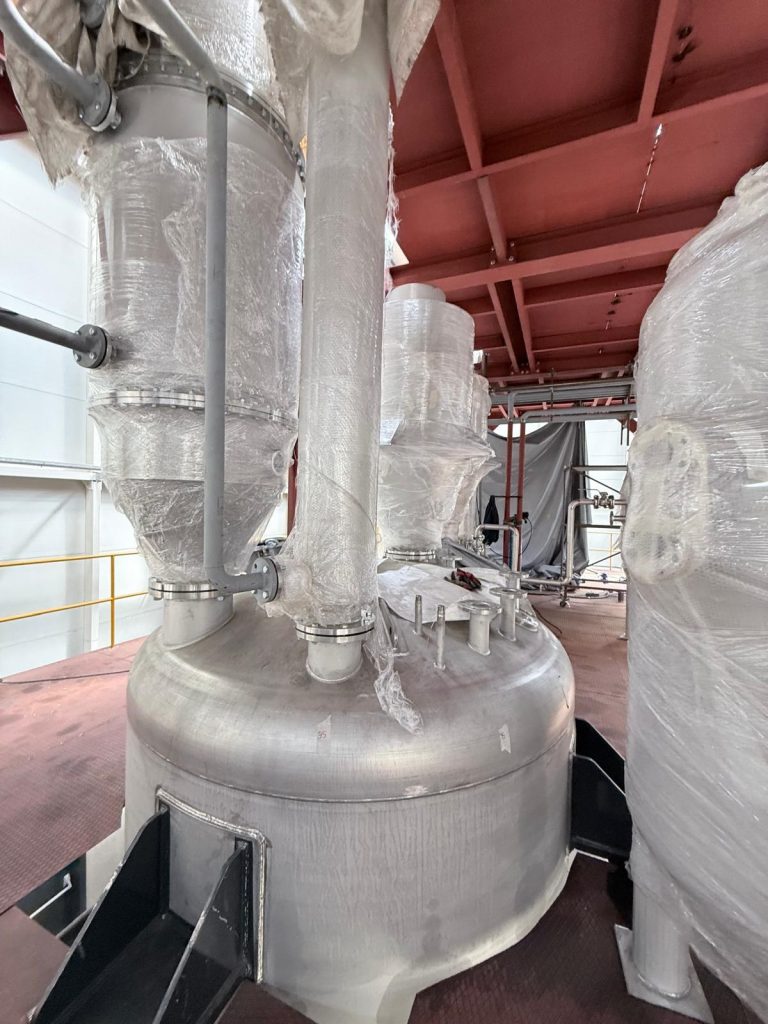
Reactive Column
Plate and packed columns engineered for efficient mass transfer, from pilot-scale units to large industrial towers for chemical and petrochemical plants.

Home / Process Equipment / Columns & Towers
Plate and packed columns engineered for efficient mass transfer, from pilot-scale units to large industrial towers for chemical and petrochemical plants.
A column is a tall, cylindrical vessel used in the chemical, petrochemical and process industries for mass transfer and separation. By maximizing contact between rising vapour or gas and descending liquid, it separates, purifies and recovers valuable products.
AtomMek columns are designed for the specific separation task, whether that is fractionating a solvent mixture, recovering raw materials from an off-gas or removing hazardous compounds before emission. Each column is built as a cylindrical welded structure with internal trays or packing for efficient phase contact.
Column height is driven by the number of theoretical stages, which links purity targets to equipment size.
We define feed composition, required distillate and bottoms purity and throughput.
Minimum stages N are estimated from the distillate and bottoms mole fractions and the relative volatility α, the classic relation between purity and design size.
Trays or packing are chosen for efficiency, pressure drop, fouling tendency and turndown.
Shell, heads, supports and nozzles are designed to ASME and CE requirements with a height-to-diameter ratio typically between 6:1 and 12:1.
Welded fabrication, testing and documentation, typically delivered within 2–3 months depending on complexity.
In paint, resin and solvent-based production, a vertical column connected perpendicularly to the mixing tank lets volatile solvents evaporate, condense and flow back into the batch. Solvent loss is prevented and the solvent is smoothly reintegrated into the mixture.
This arrangement can remove the need for a cooling jacket on the vessel, simplifying the blending process while improving safety and efficiency. We design the column, condenser and return line as one package with your reactor or mixer.
| Item | Options |
|---|---|
| Materials | Carbon steel; stainless steel 304, 316, 316L |
| Duplex grades | Duplex and super duplex stainless steel 2205, 2507 |
| Nickel and copper alloys | Inconel®, Hastelloy®, Monel®, copper-nickel alloys |
| Linings | Glass-lined, fluoropolymer-lined or alloy protection |
| Height-to-diameter ratio | 6:1 to 12:1 |
| Operating pressure | Atmospheric up to several MPa |
| Capacity | Pilot-scale to large industrial towers |
| Standards | ISO 9001, ASME pressure vessels, CE compliance, local safety regulations |
Short answers to the questions our engineers hear most often.
They are used in chemical plants for distillation, fractionation, absorption, stripping and scrubbing.
We build custom column sizes, from pilot units to large industrial towers, typically with a height-to-diameter ratio of 6:1 to 12:1.
We use glass lining, fluoropolymer lining and alloy protection, and select materials such as 316L, duplex or nickel alloys for the chemicals involved.
Standard delivery is 2–3 months, depending on complexity.
Yes. Our team supports erection, piping connection and start-up. See installation and commissioning.
Send us your feed, purity targets and capacity, and our engineers will size and design the right column for your process.